
NODA — Mission and Principles: Gas Infrastructure for Mining
Why we are building a 44 MW gas-fired site for mining and GPU servers in Perm Krai, what we believe in, and what this blog will cover. No price predictions, no signals.
We are opening this blog. So let us start with what you will not find here: forecasts of "BTC to $200k", altcoin signals, promises of 100x returns, and fine words about how "crypto will reshape the financial system". That is not our job. Our job is to turn gas into electricity, electricity into hash, and to do it in a way that keeps the client profitable at any point in the cycle.
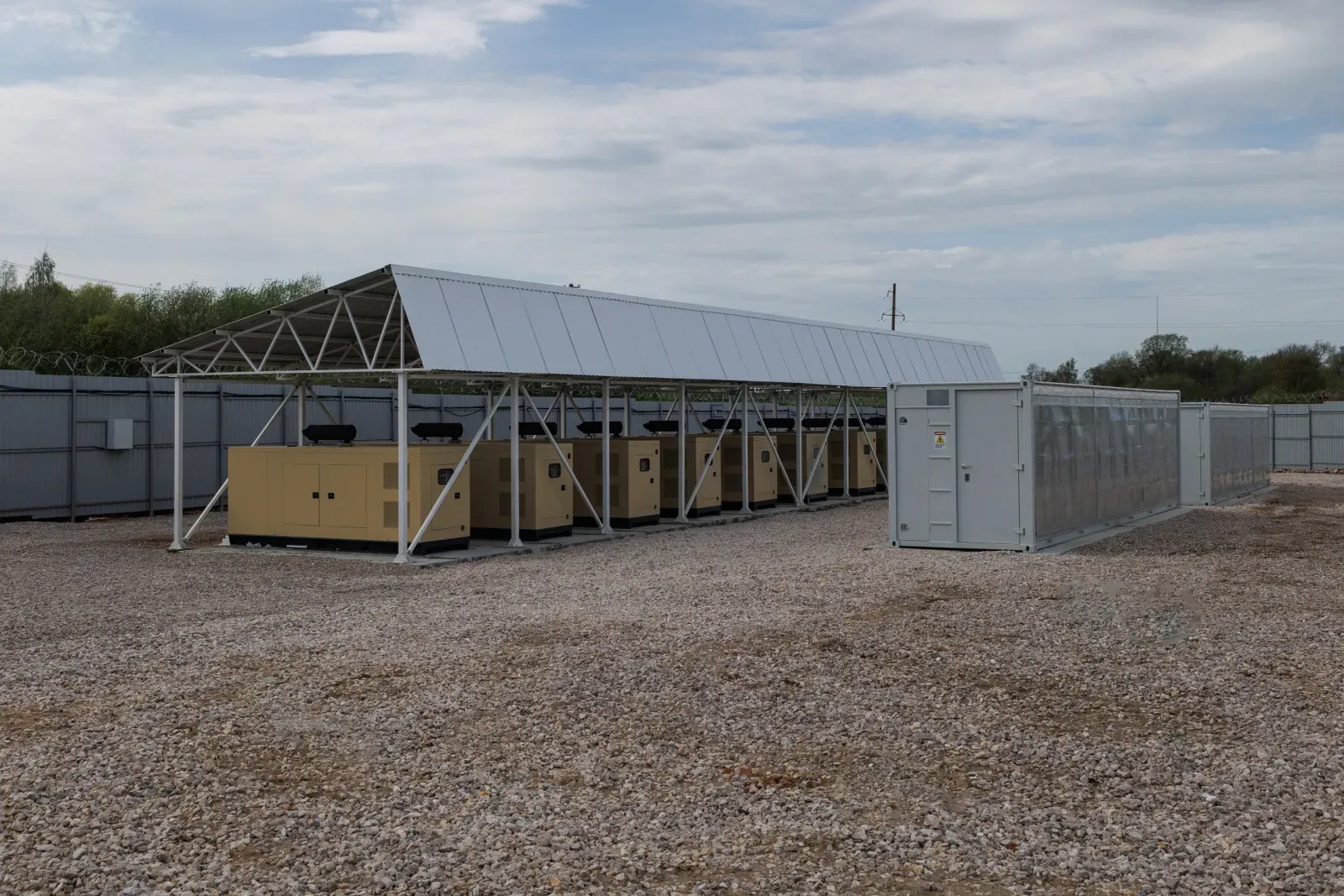
NODA is a 44 MW gas-fired site in Perm Krai. We develop our own generation, host client equipment, supply miners and GPU servers directly from manufacturers, and design turnkey data centres. A single chain of accountability, from the land to commissioning.
To make it clear where we are writing from, a short scene. Take a large global crypto exchange. Thousands of people work for it: developers, marketers, lawyers, athlete-evangelists posting on Twitter. The exchange makes its money because all of those people, and hundreds of thousands of their followers, lose their deposits every month on 100x futures. On the side that pushes the market up, there is a public corporate bitcoin accumulator — a company that issues low-coupon debt, uses the proceeds to buy BTC, and posts a "BTC to the moon" tweet every fortnight. Running in parallel is an algorithmic market-maker, nudging spot price across a thin order book to test how retail reacts via funding and Open Interest. And somewhere on the periphery of this whole arrangement sit hundreds of mining hosts that sold clients stories about a six-month payback — and then quietly shut down, holding client equipment "pending clarification of circumstances".
We are not from that kitchen. We are about engineering, kWh, and a boring, calculable business. This post is about what we believe in, what we are building, and what this blog will cover next.
What we believe, and what we do not
What we do not believe in:
- The romance of "BTC will change the world". Whether it does or not, on a five-to-ten-year horizon that is neither our area of competence nor a sound basis for a client's decisions.
- Forecasts along the lines of "$200k within a year". You cannot calculate a payback period on a forecast.
- MLM evangelism, where everyone who buys in must urgently convince two more people. That is not product marketing — it is a network structure.
- Narratives about a "financial revolution" and "web3 replacing banks". Those are conference slides, not a P&L.
What we do believe in:
- BTC mining can be very profitable. That is a fact of operating economics, verifiable against any equipment manufacturer and any major pool.
- Mining is a clear industry with a clear equation: gas → kWh → hash → BTC → money. Every link can be measured and optimised.
- In a cycle, the winner is not the one who timed the entry, but the one with the lowest BTC breakeven price. The lower your BTC breakeven price, the more of the year you spend in profit. That is the miner's business model.
What NODA does with all of this: we build infrastructure that lowers our clients' BTC breakeven price. Everything that is not about that is narrative.
What we are building: a 44 MW gas-fired site in Perm Krai
- A 3.2-hectare plot in the Ust-Kachka rural settlement, Perm Krai, east of the village of Krasny Voskhod.
- Gas-piston gensets on site. A direct gas contract — price and availability do not depend on state tariffs or the grid company's schedules.
- PUE 1.10 — under 10% losses to cooling and ancillary systems.
- Containerised data centres in 20/40 ft format, with 2N redundancy on power and cooling. Factory assembly takes 8–12 weeks, against 18+ months for a conventional data centre.
- 263 miners in a single 40-foot container (1 MW); the design maximum under the fire-safety documentation is 270 units.
- Three ways of working with a client: a mining hotel (equipment hosting), supply of miners and GPU servers, and a turnkey data centre.
Three principles behind NODA's work
Control instead of dependence
Our own generation and a direct gas contract are not about being cheap — they are about being predictable. Cheapness changes; predictability does not.
While an algorithmic market-maker nudges spot price across a thin order book, testing retail's reaction via OI and funding, on our site the pistons are burning gas and turning a generator. The cost of a kWh has a physical expression, not a narrative one. Over the term of the contract, we know the price at which electricity reaches the miner — and the client knows exactly the same.
This becomes scarce at precisely the moment state tariffs jump after another regulator decision, while a CEX can freeze withdrawals on any given day. A fixed kWh in an unfixed world — that is the product.
Engineering at the core
The site is serviced by our own team, not by outsourcing. Maintenance of the gas-piston gensets, servicing of miners and GPU servers, 24/7 monitoring — all on our side. 2N redundancy on power and cooling. Factory-built containers in 8–12 weeks, because the engineering solutions are worked out in advance, not improvised for each client in the field.
This means: when a client's miner fails, they do not need to track down "the contractor-partner who happens to be on shift right now". The repair runs to our procedure, to our standards, under our accountability.
Legal by default: Federal Law 221-FZ and the FTS miner registry
Mining in Russia is governed by Federal Law 221-FZ (08.08.2024). We operate two legal entities within this framework:
- Grid LLC (OGRN 1257700436872) — the infrastructure operator. Responsible for the site, generation, containers and operations.
- NODA LLC (OGRN 1257700266020) — a miner in the FTS registry. Responsible for mining and settlements with the regulator.
Registering the client in the miner registry is on our side. The client does not need to work through Federal Law 221-FZ themselves, prepare documents, or deal directly with the Federal Tax Service (FTS). Accordingly, there is no risk of an unexpected visit from law enforcement a week after the client's first block.
A single chain of accountability — from the land to commissioning
Here is what usually stands between an investor and the first BTC produced: the plot (land, re-registration, cadastre), the gas (supplier contract, metering unit, limits), the generation (gensets, installation, commissioning), the containerised data centre (manufacture, delivery, connection), the equipment (procurement, customs, rack installation), operations (monitoring, maintenance, repair), and the FTS registry (registration, reporting). Seven negotiation tracks, seven contracts, seven points where something can go wrong.
NODA collapses those seven tracks into one. One contract, one legal entity as the point of contact, one centre of accountability for the result — from the plot to the first mined transaction.
Who we work for — and who we do not
We work with three types of client:
- A miner with 5 ASIC or more — they come to our mining hotel; we host the equipment, install it, put it on monitoring and register it in the registry. Launch within one day of the equipment arriving on site.
- A B2B investor building a data centre — they order a turnkey project of 1–10 MW. We design, build, commission and operate it.
- An owner of gas or associated petroleum gas — they have gas at a field that would otherwise be burned off in flares. We turn that gas into kWh and into hashrate.
Who we do NOT work for: anyone who came to crypto chasing 100x and expects the host to also feed signals into a Telegram channel. We have no signals. We have kWh, a contract and uptime. We are not promising the moon either — that is not our business and not our voice.
Five themes this blog will cover
The five themes we will be writing about:
- Regulation — Federal Law 221-FZ, the FTS registry, regional restrictions, a miner's tax reporting. What is changing, how to enter the registry correctly, which risks are real and which are invented.
- Equipment — cold comparisons of ASIC and GPU servers, with no affiliate bias. What to choose for which task, and how to model payback.
- Finance — site CAPEX, payback under different BTC scenarios (none of which we promise), leasing versus purchase, the tax shield.
- Gas power — associated petroleum gas as a resource, gas-piston gensets, the breakeven point of gas generation against grid electricity.
- Regional guides and case studies from the site — where in Russia it pays to build, what we are seeing at our own site in Perm, real operating data.
The anchoring rule: in this blog we write what can be calculated. Forecasts, signals and "moon" calls — we do not write.
Frequently asked questions
What is NODA? Gas infrastructure for mining and GPU servers in Perm Krai: our own 44 MW site with gas-piston gensets, containerised data centres, hosting of client equipment, and turnkey data centre projects.
Where is the NODA site located? Perm Krai, the Ust-Kachka rural settlement, east of the village of Krasny Voskhod. A 3.2-hectare plot with a gas potential of 44 MW.
How does NODA operate under Federal Law 221-FZ, and who is accountable to the FTS? Grid LLC is the infrastructure operator; NODA LLC is a miner in the FTS registry. We take on registering the client in the miner registry; the client does not need to work through the law themselves.
Why is gas generation about predictability rather than being "cheap"? A direct gas contract fixes the cost of a kWh for the term of the contract. Unlike a grid tariff, this cost does not jump after regulator decisions and is not exposed to scheduled outages. Lower cost is a consequence, not the goal.
What is the minimum volume to start working together? Mining hotel — from 5 ASIC. Turnkey data centre — from 1 MW. Equipment supply — from a batch sized to a specific task.
How is NODA different from other mining hosts in Russia? Our own gas generation (rather than rented grid capacity), our own engineering team on site (rather than outsourcing), a single chain of accountability from the land to commissioning (rather than a chain of contractors), and full compliance under Federal Law 221-FZ.
If you are reading this post and recognise your own task in it — request a specification and commercial proposal within 5 days. Send the parameters (capacity, equipment type, timing) to contact@nodagroup.ru or to our Telegram bot @nodasalesbot.
What is next on the blog: a breakdown of Federal Law 221-FZ for the private investor, an operating report on the Whatsminer M60S++ at our site, and a comparison of gas generation against the grid tariff on concrete figures. Subscribe so you do not miss it.